At their E3 2016 press conference, Bethesda surprised fans by bringing Arkane Studios on stage to announce a brand new project: Prey. Fans were disappointed when the previously announced Prey 2 was canned after the surprisingly attractive game made a huge splash at E3 2011. The new game appears to be a complete reboot of the franchise with little or no connection to the original. Little else beyond the cinematic trailer has been revealed about the game at this time, though it is scheduled for release sometime in 2017 and will be available on PC and current-gen consoles.
Telltale Games has released an in-engine trailer for the upcoming third season of their The Walking Dead series of games. The game will be set a few years after Season 2, and Clementine is confirmed to be returning. Players with saves for the first two seasons will find the decisions they made have an impact on the story in Season 3. Along with Clementine, players will be taking control of a new character, Javier, who is described on the Telltale blog as “a fellow survivor who has been through hell, and has managed to remain alive as long as Clem.” Little else was revealed about the game, but it is expected to be released this fall.
Telltale’s Batman game was announced at last year’s The Game Awards in December. Telltale has arrived prior to the start of this year’s E3 to unveil some screenshots of the upcoming adventure game. Also revealed is the game’s voice cast which features Troy Baker as The Bat himself. The list of voices joining Troy Baker in the game’s cast is as follows: Travis Willingham as Harvey Dent, Erin Yvette as Vicki Vale, Enn Reitel as Alfred Pennyworth, Murphy Guyer as Lieutenant James Gordon, Richard McGonagle as Carmine Falcone, and Laura Bailey as Selina Kyle. Telltale is promising more reveals of characters and cast as the season progresses.
Kevin Bruner, Telltale’s CEO, said the following about their upcoming Batman game:
“We’ve been hard at work at Telltale creating an all-new iteration of the iconic Batman story that puts players in the suit of billionaire Bruce Wayne, just as much as it will put them behind the mask, deciding how to carefully navigate a complex drama, rich with action, crime, corruption, and villainy lurking around every corner of Gotham City. The complex life and fractured psyche of Bruce Wayne has lent itself to becoming a bold evolution of the signature ‘Telltale’ role-playing experience, and we couldn’t be more excited as we prepare to debut the series to players across the world this summer.”
Doom is synonymous with FPS. Early games in the genre were dubbed “Doom Clones” and often carried the stigma of never being quite as good as the id-developed shareware hit. Doom II landed in 1994, just one year after the original, but things would be pretty quiet for the franchise for about a decade after, with Ultimate Doom and Final Doom being the endcaps on the original Doom saga. Doom 3 brought some new life to the franchise in 2004, focusing more on jump scares and horror elements than just mowing down endless hordes of hellspawn, serving as a reboot to the franchise, but, again, things would go quiet. There was one expansion, Resurrection of Evil, and several promises of a sequel, but that would never see the light of day.
Fast forward another decade, and enter Doom – no numbers, no subtitles, just DOOM. Yet another reboot of the franchise, Doom the new brings things back to a more traditional styled action-oriented shooter experience.
The game begins with absolutely no exposition – not unlike starting up the original DOS classic. You play the voiceless DOOM MARINE and awaken bound to a table and surrounded by grotesque minions of hell. Evil things need killing and you have the means to do so. That’s your motivation, and that’s all the exposition you get as the game thrusts you head first into a nonstop killing spree. There is plenty of story in Doom, though, and you’ll encounter it by way of data logs, infrequent cutscenes, and bits of text on loading screens. It gives you enough motivation to continue killing (because just shooting ugly bastards may not be enough for modern audiences), but never actually gets in the way of said killing. It’s a story that does its job to keep you interested for the ten to fifteen hours it’ll probably take you to beat (it took me around 20 on Hurt Me Plenty) but it, thankfully, never takes itself too seriously.
The impressively large single player campaign is composed of 13 huge levels – all of which feature a smattering of secret areas and collectible items. Progression through the game feels similar to a hybrid of classic Doom and Metroid Prime, with sprawling levels and moderate backtracking to get to the next area after picking up a colored keycard or new ability. There’s plenty to go back for if you’re a completionist with dozens of well-hidden secrets to test your exploration skills, gameplay challenges for meeting certain requirements in any given level, not to mention just how damned fun the game is. It’s incredibly replayable.
Gunplay in the new Doom feels absolutely fantastic. Guns have weight, shots have impact, and, just like the game that spawned the series, there’s no reloading. You’ve got a number of rounds in your inventory, sure, but you never have to actively reload your guns which have seemingly endless clips. Ammo is always in abundant supply, as well. The game never leaves you out to dry and, if you do begin to run low on rounds, you can whip out the powerful chainsaw for a quick, on-demand ammo drop when you rip through a nearby enemy. To keep things balanced with the chainsaw, which can take down any non-boss enemy with one hit, the weapon runs on fuel and harder enemies will consume more fuel – so a possessed will take one bar of fuel, a revenant will take three, and a mancubus will take five. As powerful as you feel never having to pause to reload, the game makes sure you never feel too powerful at any given time. There’s plenty of death to be had in Doom and, depending on your difficulty, you’ll probably get more than your fair share.
Outside the campaign, the game offers a variety of multiplayer modes in addition to a scenario editor called Snap Map. While the multiplayer modes have received little love from fans and press alike, Snap Map opens up endless possibilities for new gaming experiences. It’s basically Super Mario Maker with guns. And demons. And gobs of goo. Snap Map is impressive in how much you can do with it – everything from the map layout, enemy placement, items, spawns, and sound effects are up to you. You can place interactive switches that trigger events in the level, program paths and behaviors for your enemies, set conditions and objectives to win your scenario. It’s a great, simple to use tool that basically makes you an FPS dungeon master in charge of mini campaign. The community offerings are hit and miss, to be sure, but there is so much potential with what is possible the Snap Map tools that you can spend countless hours in this game – whether you’re constructing your own scenarios, or playing maps posted by the community.
The resurgence of id’s iconic properties like Wolfenstein and Doom is exciting to me as someone who grew up with those properties for the nostalgic value, but also to see how well the franchises can hold up in these new iterations. Much like Wolfenstein: The New Order that came before it, Doom is absolutely worth a playthrough. The multiplayer may leave you wanting, but the campaign and snapmap community should keep you satisfied for, potentially, endless hours.
It’s hard to think that ten years ago, now, I was taking my first trip to Albion – a curious land that would devour hours of my time and earn my devout allegiance. Fable has never been known for a lengthy main campaign, but the games have always offered a substantial amount of side content and secrets that encourage players to invest more than the 10 or so hours it would take to just beat the game. The franchise has been the victim of its own over-hyping, but nonetheless it’s a franchise I hold near and dear to my heart and I’m thrilled that I now have the opportunity to replay the first game, my personal favorite, fully remade.
Fable is an interesting beast. As a friend of mine has described the games, “It’s very British.” It’s a cheeky game with some great hit-or-miss humour but all wrapped in a charming package with a great story. The storytelling in Fable has never been high art or anything of that sort, but the games always have a well-crafted, non-linear plot, something I appreciate. The Fable universe has been keeping me entertained and intrigued for ten years now, and I’m pleased to say that the re-release more than does the premiere installment justice.
I’ve really grown to appreciate how Microsoft handles their remakes. While you see a ton of “HD” re-releases from the last console generation hitting the market from several other publishers, those games suffer from a severe case of “uprezzing.” Little more is done with those titles than giving players new high-resolution textures and widescreen support to stare at – the visuals are still relatively unchanged from the initial game release. Now new character models, no new particle effects, no new lighting, no new audio… it’s the same game but just a bit (and I mean a bit) shinier.
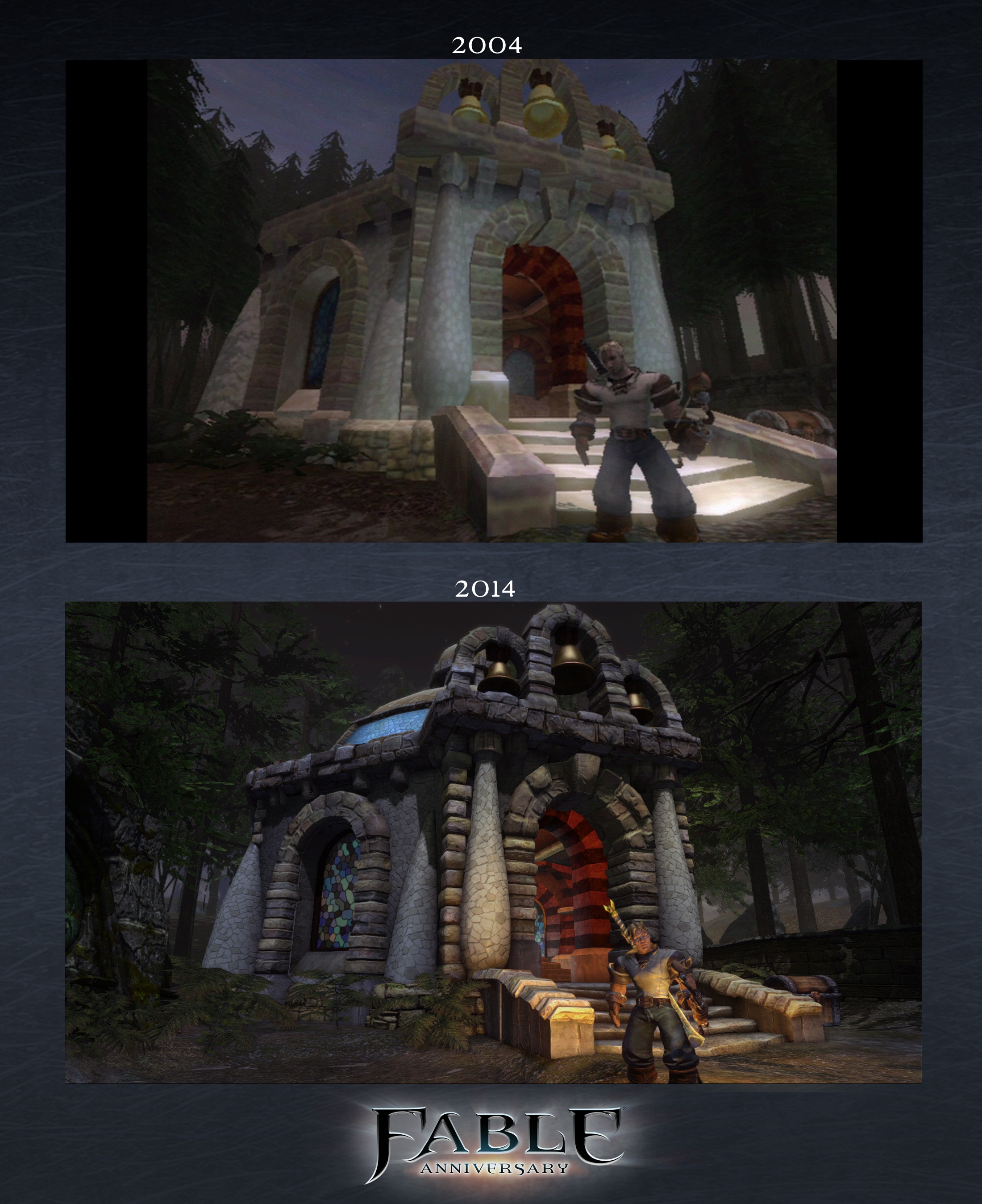
Microsoft Studios, on the other hand, completely remakes the game visually. The original game content and experience is untouched (aside from maybe some new controller options) while the game’s visuals are rebuilt with maybe a healthy helping of new audio to go along with it (with Halo: Combat Evolved Anniversary being a prime example of new audio really lending to the rebuilt experience). It’s not just a high resolution copy of an already made game, it’s a complete visual reimagining of a world we’re already familiar with. Perfect Dark and Halo really demonstrated that Microsoft was dedicated to nurturing its properties and giving fans more than just a recycled product. Fable does the same.
While the gameplay may not hold up as well next to its more modern counterparts, the experience that I loved ten years ago is still there. The belching, the farting, the questing… it’s still the classic Fable experience that so consumed much of my mid-to-late teen years and every moment I spend in the game is accompanied by a nostalgic high. I love Fable and this is the game that always comes to mind when I think of revisiting Albion… I’m almost ashamed that it’s been so long since I’ve worked my way through the first game (which, I’ll admit, I haven’t played through since Fable II was released). I’m not, though. Playing through Fable Anniversary, in spite of the many, many times I’ve played through the first game, is, amidst the nostalgia, almost a new experience again since it has been so long. It feels fresh, yet familiar and not just because of the visual update.
The visuals, though, are great. It’s really nice to see that such a great amount of care went into rebuilding the world of Albion. It is, however, hindered by the aged and clunky animations of the 2004 game hiding underneath. While some things feel revamped and fluid, there are those awkward moments where characters will freeze and whip around robotically. It’s jarring and takes from the experience ever so slightly – but as a whole, the game looks great and the love that went into recreating Albion is apparent in every screen.
I know I may be biased and looking at the game through rose-tinted glasses or whatever, but Fable Anniversary feels great. Playing the game brings me some kind of gaming bliss and the new visuals should set a new standard for HD remakes – something I also said about Halo: Combat Evolved Anniversary. I feel like the folks working under the Microsoft Studios banner aren’t given enough credit for the work they do on their HD remakes – though that’s a topic for another time, I suppose.
Fable Anniversary is an old game dressed in new game clothing. It’s as fun as it was ten years ago, but looks substantially better. Giving loyal Xbox fans achievements to earn is another plus. Fable is a piece of gaming history and this Anniversary re-release does it justice, it would be hard, even when not considering my bias, to not recommend this game… it’s just too much fun and the budget price makes it even more enticing.
No, not Rare – Microsoft is likely to never give them up after the massive investment that purchased the studio back in 2002. The developer of the new Killer Instinct title released on Microsoft’s Xbox One Double Helix has been acquired by Amazon and is a part of their push to “build innovative games for customers.”
The acquisition, unsurprisingly, does not affect Microsoft’s Killer Instinct property which remains theirs; the software giant has also announced that their internal KI team is unaffected and remains dedicated to supporting the game. Microsoft will be working with a new partner going forward to support the Xbox One launch title and any additional entries in the franchise. As a dedicated KI fan, this is the good news. While I was thoroughly pleased with the latest entry in the franchise and commended Double Helix for resurrecting it, I have faith that Microsoft will do well by the fans in curating this fan favorite franchise.
Amazon’s move to acquire a game developer is not terribly surprising given rumors that the online retailer is working on a game console of their own. At this point, it’s unclear if Double Helix will work on more major releases or “full” games or will be restructured to focus on casual games for Amazon’s Kindle Fire line of tablets.
Neill Blomkamp has a history with Halo: he was attached as the director of the Peter Jackson produced Halo film that fell apart some years back and he directed the live action Halo 3 promotional film. He knows the universe and his style is a perfect fit for the Haloverse. That said, it’s very exciting that Blomkamp may be directing the première episode of the Halo television series that was announced for Xbox One. While this has yet to be officially confirmed, the thought of a Blomkamp directed episode of the Halo TV series is exciting.





 PowerUp Online